No-Spend Challenge: Rules + a 30-Day Plan
Pause non-essential spending for a fixed period. The difficulty is not willpower — it is writing rules clear enough to follow and surviving the social pressure in week three.
Quick answer: A no-spend challenge means pausing all non-essential spending for a set period — usually a week or a month — while continuing to pay bills, rent, debt and other essentials. The point is not deprivation. It is finding out where your money actually goes when the automatic purchases stop.
Write the rules first — this is the whole game
Almost every failed no-spend month fails for the same reason: the rules were never written down, so every purchase became a negotiation. Is a coffee with a friend a social obligation or a non-essential? If you decide in the moment, you will decide yes, every time.
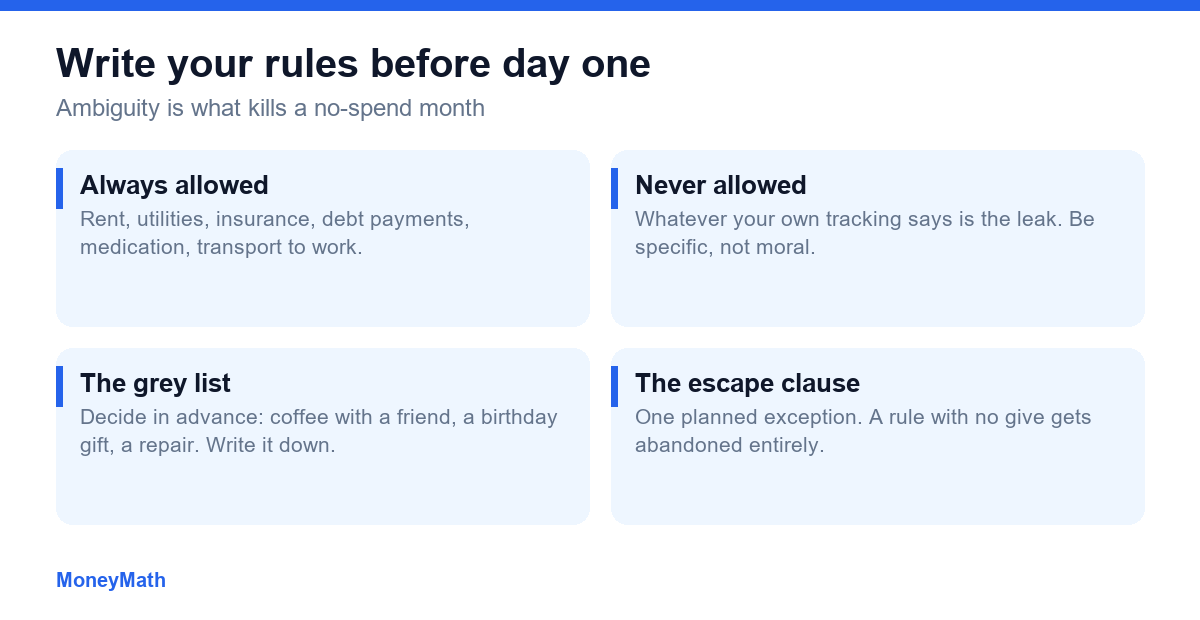
The grey list is the one that matters. Write it before day one and be specific: a birthday gift for your mother, a repair you have been deferring, one dinner out that was already arranged. Ambiguity is what ends these challenges, not temptation.
Note the escape clause. A rule with no give gets abandoned wholesale the first time life intervenes. One planned exception makes the other twenty-nine days survivable.
Essentials always continue
To be explicit, because people do take this too far: rent and mortgage, utilities, insurance, medication and healthcare, transport to work, debt repayments, and food all continue as normal.
Skipping a debt payment or a prescription to win a no-spend month is not a saving. It is a more expensive problem arriving later.
A 30-day plan
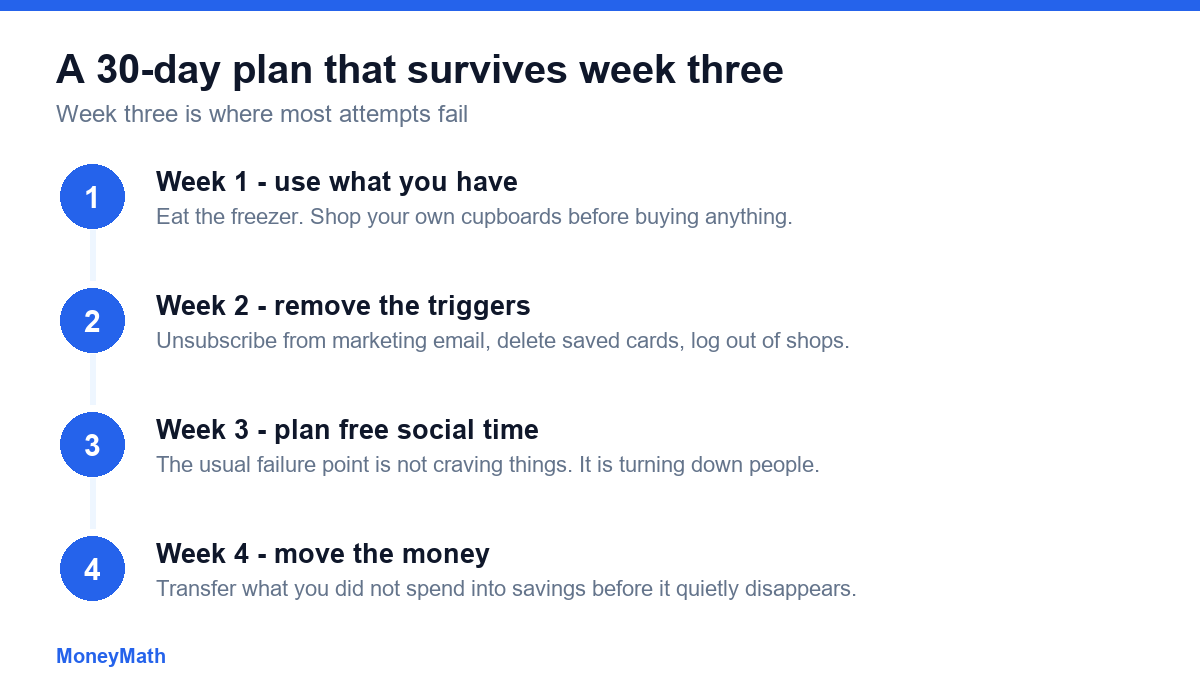
Week one is usually easy — novelty carries it. Use the momentum to eat down the freezer and the cupboards. Most households are holding one to two weeks of food they have forgotten about.
Week two is about environment, not willpower. Unsubscribe from retailer email, delete saved cards from your browser, and log out of the apps you buy from. Removing one-tap purchasing does more than any amount of resolve, because it reintroduces a decision point.
Week three is where it breaks. The failure is almost never a craving for objects — it is declining invitations. Plan free social activity in advance: a walk, a host-at-home dinner, a visit. Isolation is what makes people quit, so solve for the social cost rather than trying to endure it.
Week four is the part everyone skips. Money you did not spend does not save itself. If it sits in your current account it will be absorbed invisibly. Transfer it out the day the challenge ends.
The rebound problem
The most common way a successful no-spend month produces no savings at all: a week of celebratory spending afterwards that erases the entire gain.
Two things prevent it. First, move the money to a separate account immediately, so the balance you see does not look like a windfall. Second, decide before you finish which specific habits you are keeping — because the real value of the exercise is not the one month's saving, it is discovering which of your regular purchases you did not actually miss.
Keep a short list during the month. Anything you never thought about again is a permanent cut. Anything you genuinely missed goes back, without guilt.
Choosing a length
- A no-spend week is a good first attempt. Long enough to reveal patterns, short enough that nothing important gets deferred.
- A no-spend month is the standard version, and long enough to break habits rather than just pause them.
- A partial challenge — no takeaways, or no online shopping, for a month — often outperforms a total ban, because it targets the actual leak and is far easier to sustain.
If you are unsure which category is the leak, a 50/30/20 budget breakdown against your real spending will usually make it obvious within a minute.
Frequently asked questions
What is a no-spend challenge?
A set period — commonly a week or a month — during which you pause all non-essential spending while continuing to pay bills, rent, debt and other essentials.
What counts as essential?
Housing, utilities, insurance, medication and healthcare, transport to work, debt repayments and food. Anything required to stay housed, healthy, employed and current on obligations continues as normal.
How much can you save in a no-spend month?
It depends entirely on your current discretionary spending. The more useful outcome is not the total but the discovery of which regular purchases you did not miss at all.
Why do no-spend challenges fail?
Two main reasons: rules that were never written down, so every purchase becomes a negotiation, and social pressure in the third week. Both are solved in advance rather than in the moment.
What should I do with the money afterwards?
Transfer it to a separate savings account or against debt on the day the challenge ends. Money left in a current account is usually reabsorbed within a fortnight.
The bottom line
A no-spend challenge is a diagnostic more than a savings method. Write specific rules before you start, keep every essential running, plan for the social cost in week three, and move the money out the day you finish. The permanent value is the list of things you stopped buying and never missed.