Cash Stuffing Explained: A Beginner Guide
Withdraw your variable spending money, split it into labelled envelopes, and stop when an envelope is empty. Here is how to set it up, and where the method genuinely does not work.
Quick answer: Cash stuffing means withdrawing your variable spending money each payday and dividing it into labelled envelopes — groceries, fuel, eating out. You spend only what is in each envelope, and when it is empty, that category is finished until next payday. It is envelope budgeting, rebranded.
Why physical cash changes behaviour
The method is old — it long predates the social media trend — and its effect does not come from clever budgeting. It comes from friction.
Handing over notes and watching an envelope thin out registers differently from tapping a card. A card gives no running feedback: the balance is abstract, the limit is invisible, and the consequence arrives weeks later on a statement. An envelope tells you exactly where you stand every time you open it.
There is also a hard stop. Digital budgets are advisory — you can always overspend a category and reconcile it later. An empty envelope is not advisory.
Setting up your first month
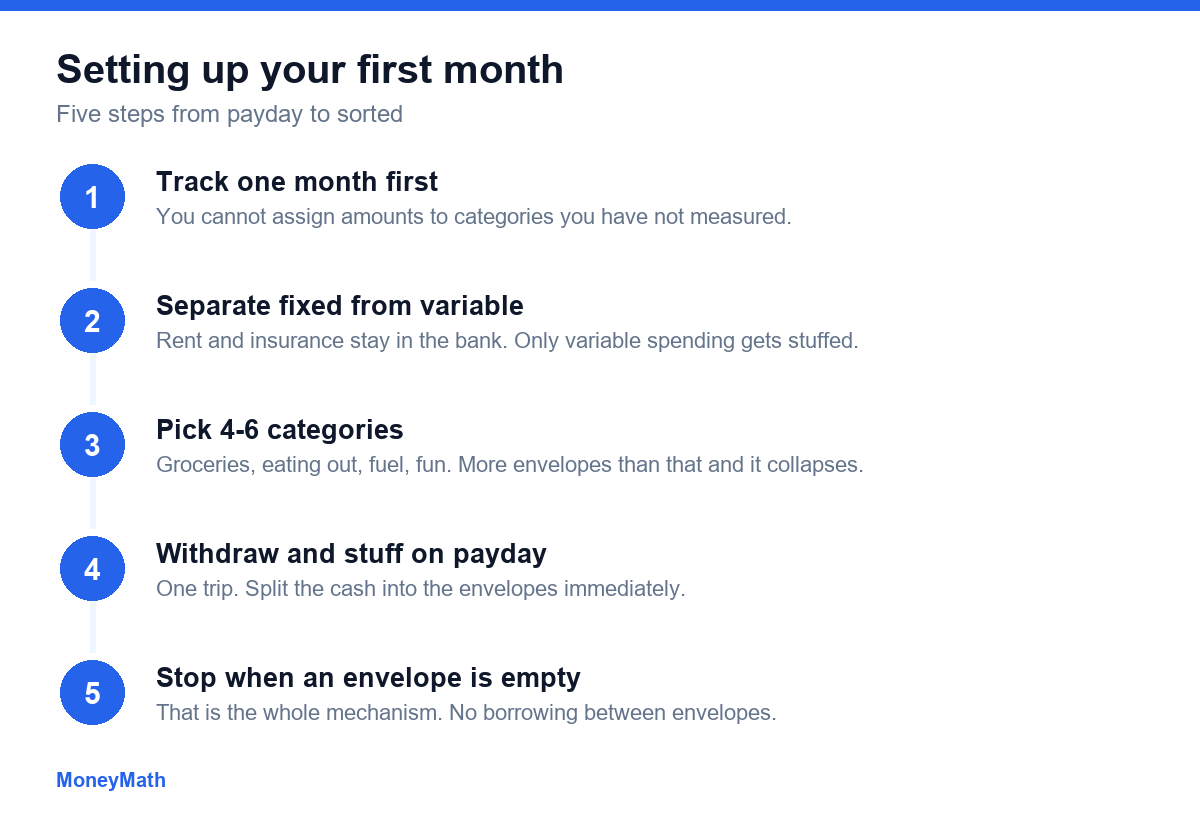
Step one is the one people skip, and skipping it is why most attempts collapse in week two. If you guess that groceries cost $400 when they actually cost $650, you will run out on day eighteen, raid another envelope, and conclude the method does not work. It was the number that was wrong.
Track one honest month first. Then set the envelope amounts from what you actually spend, and cut deliberately from there.
On categories: four to six is the working range. Every additional envelope adds admin and increases the chance of the whole system being abandoned. Groceries, eating out, fuel or transport, and personal or fun spending covers most people.
The cash stuffing calculator will split a take-home figure across categories so you can see whether your numbers actually add up before you withdraw anything.
What never goes in an envelope
Only variable spending gets stuffed. Rent, mortgage, insurance, utilities, subscriptions and debt payments stay in the bank and stay automated. They are fixed, they are usually paid by direct debit, and converting them to cash creates risk with no benefit.
The method targets the spending that responds to attention. A direct debit does not respond to attention.
An honest look at the downsides
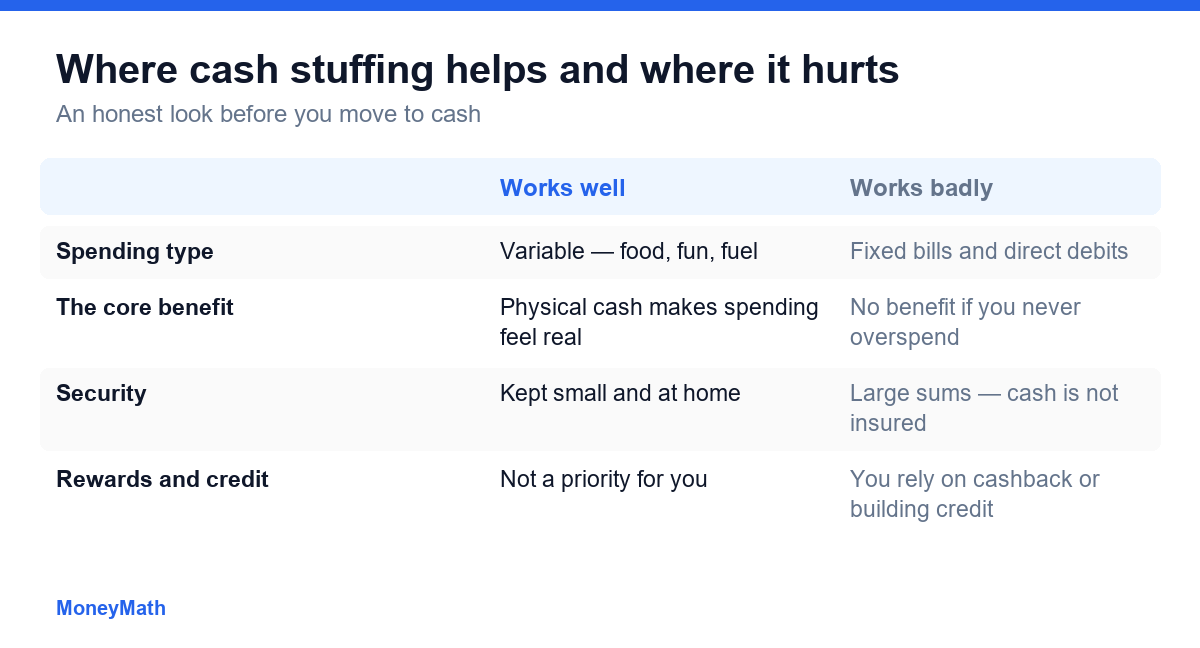
Cash is uninsured. Money in a bank account is protected up to the deposit insurance limit. Money in a drawer is not. If it is lost, burnt or stolen, it is simply gone. Keep the amounts modest and do not use this method to store savings.
You forfeit rewards and credit history. Paying cash means no cashback, no purchase protection, and no contribution to your credit file. If you already pay your card in full every month, you are giving up real value for a discipline mechanism you may not need.
It is inconvenient. Online purchases, fuel pumps and an increasing number of venues assume a card. Most people end up running a hybrid: cash for the categories they overspend, card for everything else.
It does not fix an income problem. If your essential costs exceed your income, no envelope system resolves that. Budgeting reallocates money; it does not create it.
Who it genuinely helps
Cash stuffing works best for people who know they overspend on variable categories, have tried app-based budgeting and ignored the notifications, and respond to physical, visible feedback.
It is largely unnecessary for people who already underspend their budget, carry no revolving debt, and find digital tracking sufficient. There is no prize for making your finances harder to run.
Practical rules that make it stick
- No borrowing between envelopes. The moment groceries can raid eating-out, the hard stop is gone and you are back to an ordinary budget.
- Roll leftovers forward deliberately. Decide in advance: either it carries to next month's envelope or it goes to savings. Leaving it undecided means it gets spent.
- Keep a small buffer envelope for genuine surprises, so one unexpected cost does not break the whole system.
- Do one withdrawal per payday. Repeated ATM trips reintroduce exactly the frictionless spending you were trying to remove.
Frequently asked questions
What is the cash stuffing method?
Withdrawing your variable spending money each payday and dividing it into labelled envelopes by category. You spend only what is in each envelope, and stop when it is empty. It is a physical version of envelope budgeting.
How many envelopes should I use?
Four to six. Enough to separate the categories where you actually overspend, few enough that the system stays manageable. More envelopes means more admin and a higher chance of abandoning it.
Should bills go in envelopes?
No. Fixed costs like rent, insurance and utilities should stay automated in your bank account. Only variable spending that responds to attention benefits from being converted to cash.
Is cash stuffing safe?
Cash at home is not covered by deposit insurance and is not recoverable if lost or stolen. Keep the amounts to one pay period of variable spending, and never use envelopes to store savings.
Does cash stuffing hurt your credit score?
It does not damage your score directly, but paying cash means you are not building credit history through card use. If you are working on your credit file, keep some regular card activity that you pay off in full.
The bottom line
Cash stuffing is a behavioural tool, not a financial strategy. It works because physical money creates friction and a hard stop that digital budgets lack. Track a real month first, stuff only variable spending, keep the amounts small enough to lose safely, and skip it entirely if you already control your spending.
Use the cash stuffing calculator to split your take-home pay across categories before you withdraw a thing.