52-Week Money Challenge: Chart, Printable and Variations
Save $1 in week one, $2 in week two, and $52 in week fifty-two. Total: $1,378. Here is the full chart, and the variations that people are far more likely to finish.
Quick answer: The 52-week money challenge means saving $1 in week 1, $2 in week 2, and so on up to $52 in week 52. The total is $1,378 — because the numbers 1 through 52 add up to 1,378. Average cost: about $26.50 a week.
The structure, and its one design flaw
The appeal is obvious. Week one costs a dollar. Anyone can save a dollar. The ramp is so gentle that the habit is established long before the amounts get serious.
The flaw is equally obvious once you look at a calendar. If you start in January, the most expensive weeks — 49, 50, 51 and 52, totalling $202 — land in December. You are asked for the largest deposits of the entire year during the most expensive month of the year.
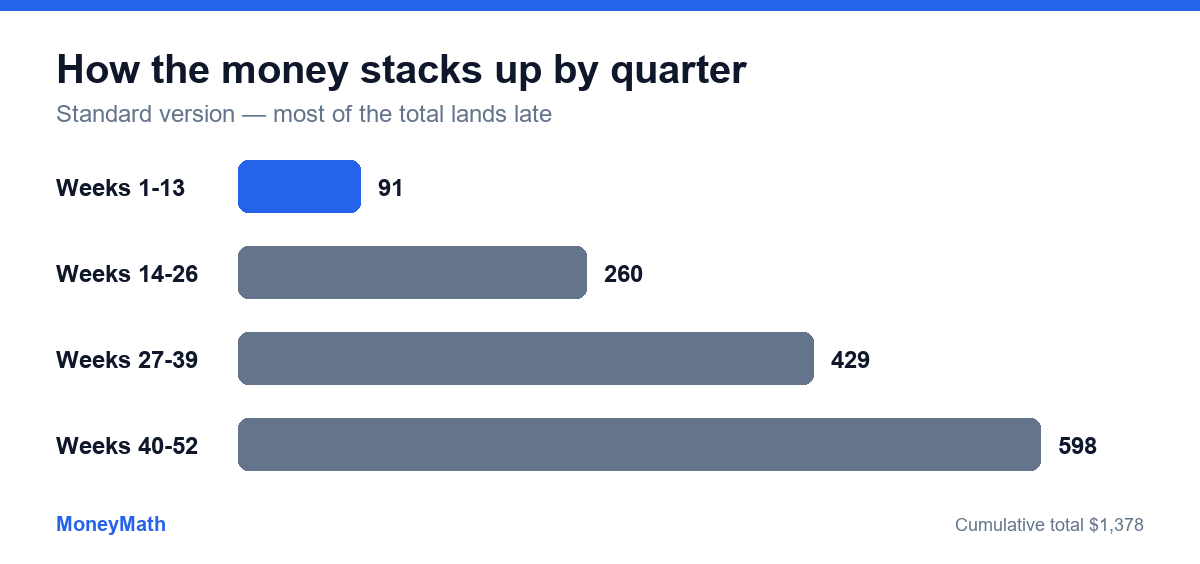
The chart makes the imbalance concrete. The first quarter contributes $91 — under 7% of the total. The final quarter contributes $598, or 43%. Most of the work happens when most people have the least slack.
The reverse challenge fixes this
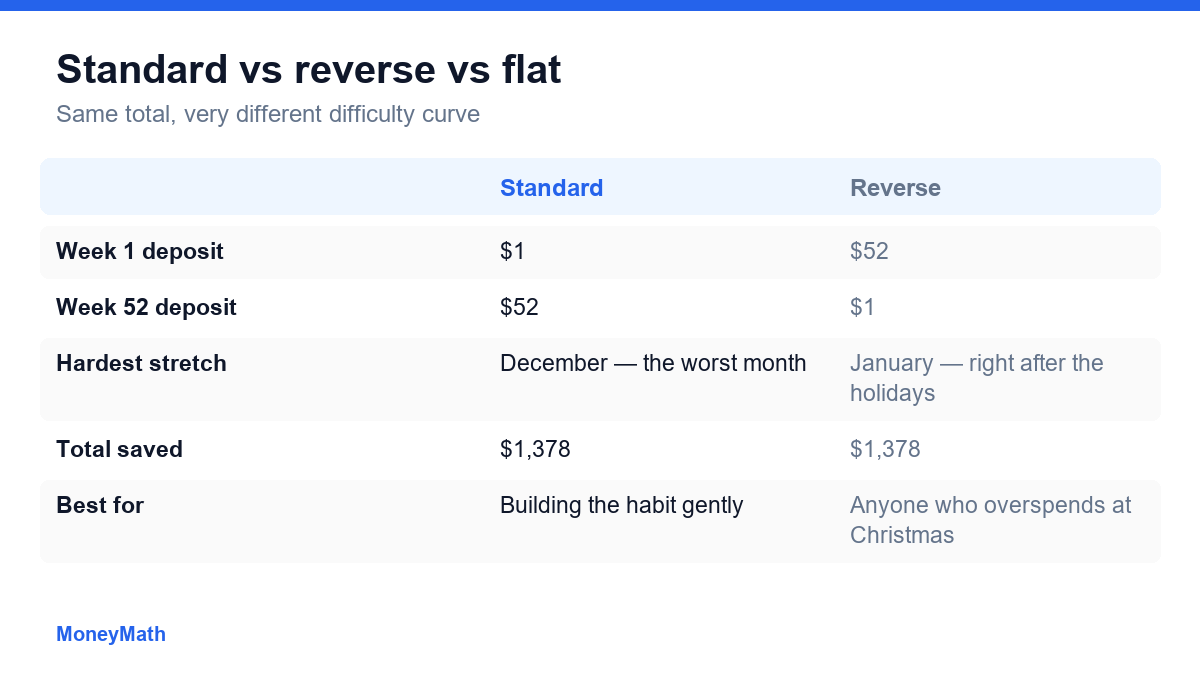
Run the numbers backwards — $52 in week 1, down to $1 in week 52 — and you save exactly the same $1,378. What changes is when the difficulty lands. The hardest weeks fall in January and February, and the challenge gets easier every single week thereafter.
This suits anyone who overspends at Christmas, which is most people. It also means December costs you $10 in total rather than $202.
The flat version
If your income is irregular — freelance, gig work, commission — both ramped versions fight against you, because the required amount has nothing to do with what you earned that week.
Saving a flat $26.50 every week reaches the same $1,378. It is less satisfying and far more predictable. For anyone budgeting on a variable income, predictable usually wins.
A fourth option: percentage-based. Save a fixed share of each payment as it arrives. The amount flexes with your income automatically, which is the only version that genuinely survives a bad month.
Where to keep the money
Unlike cash-based challenges, there is no reason to hold this in physical money. A separate savings account with a standing transfer does three useful things: it earns interest, it is insured, and it removes the weekly decision entirely.
Automate it and the challenge becomes a scheduling problem rather than a willpower problem. That is the single biggest predictor of finishing.
One warning: do not keep it in your main current account. Money that sits next to your spending money gets spent, usually without a decision being made at all.
What $1,378 is actually for
A year is a long commitment for a sum that will not change your life. It is worth being precise about what it buys.
$1,378 is a genuine starter emergency fund — enough to cover a car repair, an insurance excess, or a boiler replacement without reaching for a credit card. Research on household finances consistently finds that a buffer of this rough size is what separates a bad week from a debt spiral.
What it is not is a wealth strategy. If you have high-interest debt, the interest you are paying will exceed anything this saves you. Clear that first.
Finishing it
- Automate the transfer for the day after payday, not the day before.
- Print the chart and cross weeks off. Visible progress is the mechanism that makes these challenges work at all.
- Double up when you can. A bonus or refund week is the moment to knock out three of the expensive weeks early.
- Never restart from week one. Missing a week is not failure. Restarting because you missed a week is how the challenge dies.
Frequently asked questions
How much do you save in the 52-week money challenge?
$1,378, because the numbers 1 through 52 add up to 1,378. That averages about $26.50 per week.
What is the reverse 52-week challenge?
You start with $52 in week one and decrease by $1 each week, finishing with $1. The total is identical at $1,378, but the hardest weeks fall in January rather than December.
Can I do the 52-week challenge with a flat amount?
Yes. Saving $26.50 every week reaches the same total. This works far better on an irregular income, where a ramped schedule bears no relation to what you earned that week.
When should I start the 52-week challenge?
Any week works. If you start in January, strongly consider the reverse version so the expensive weeks do not land in December.
Where should I keep the money?
A separate savings account, not your current account and not cash at home. You get interest, deposit insurance, and enough separation that you do not spend it without deciding to.
The bottom line
The 52-week challenge is a good habit-builder with one scheduling flaw. Run it in reverse, or flat if your income varies, automate the transfer, and put the money somewhere separate from your spending.
Use the 52-week savings challenge calculator to see the full week-by-week chart for whichever version you pick.