How the 100 Envelope Challenge Works (+ Printable Tracker)
Draw a numbered envelope each day, put that many dollars inside, and finish with $5,050 in 100 days. Here is the maths, the variations for smaller budgets, and the parts nobody mentions.
Quick answer: The 100 envelope challenge means numbering 100 envelopes 1 to 100, drawing one at random each day, and putting that many dollars inside. Because 1 + 2 + 3 … + 100 equals 5,050, finishing every envelope saves $5,050 in 100 days — an average of $50.50 a day.

How it works
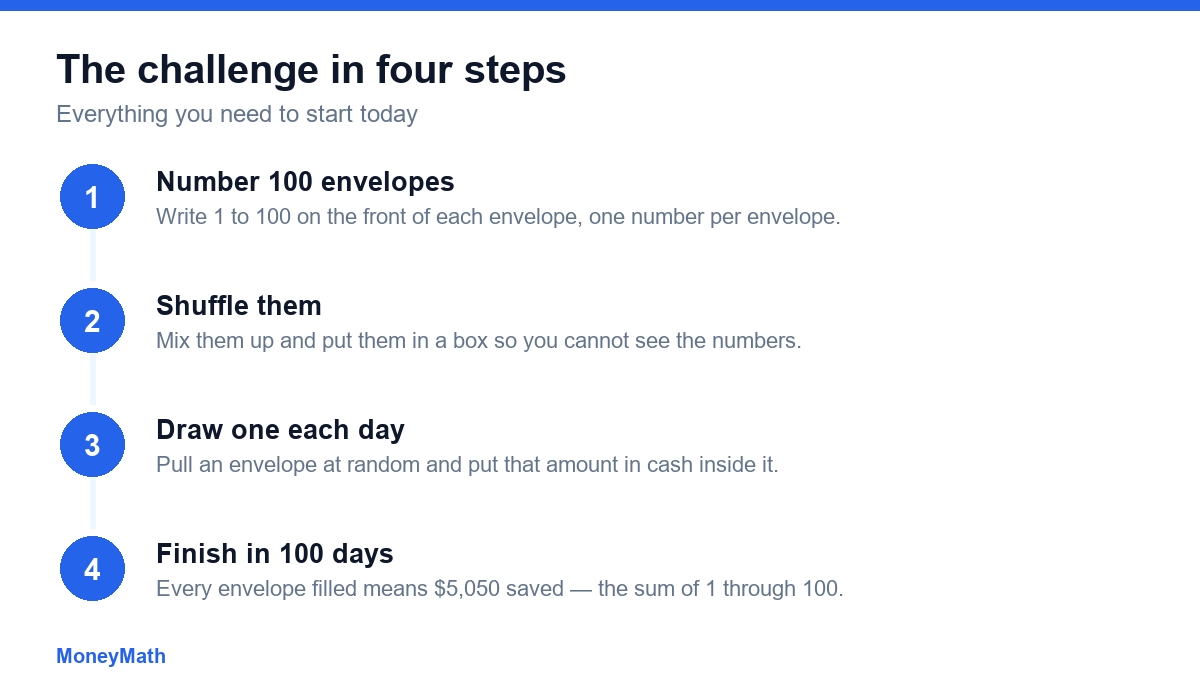
The randomness is the entire point. If you filled the envelopes in order you would face the painful $90-plus days in a single brutal stretch at the end. Drawing at random spreads the large and small amounts unpredictably, so a $97 day is usually followed by a $12 day.
It also removes the decision. You are not choosing how much to save today — the envelope chose. For a lot of people that is the difference between saving and negotiating with themselves every morning.
The maths, checked
The total comes from a formula worth knowing, because it lets you price any version of the challenge instantly. The sum of the numbers 1 to n is:
n × (n + 1) ÷ 2
For 100 envelopes: 100 × 101 ÷ 2 = 5,050. For 50 envelopes: 50 × 51 ÷ 2 = 1,275. You can check any variation in one line.
Variations that people actually finish
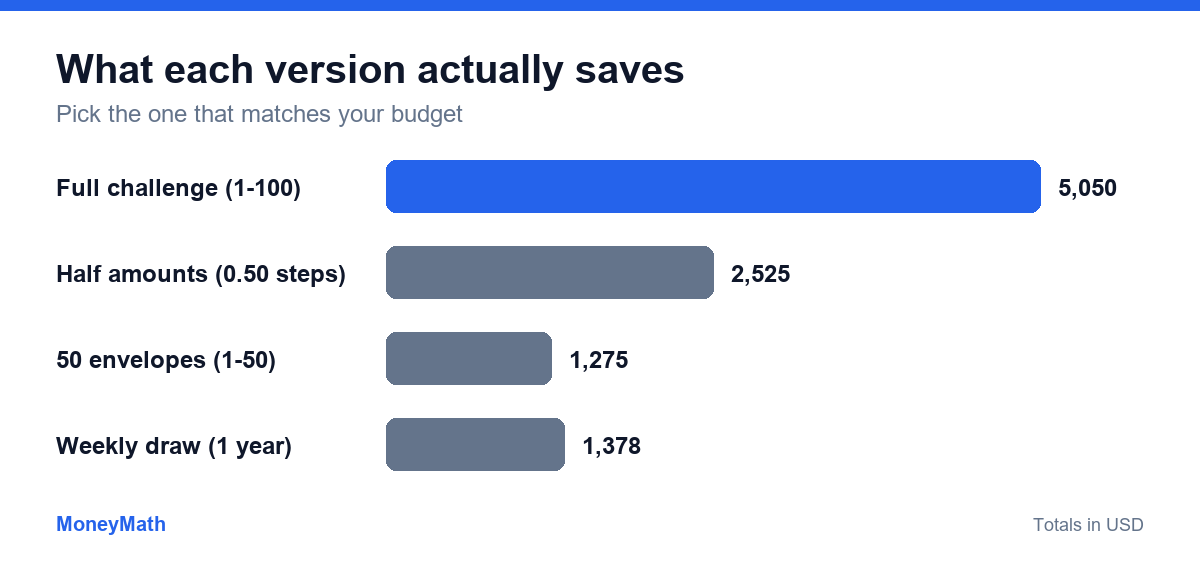
$50.50 a day is a lot. Most people who abandon the challenge do so because they picked the full version on a budget that could never sustain it. Pick a version you can finish:
- Half amounts. Draw envelope 74, save $37. Same structure, half the pressure, $2,525 at the end.
- 50 envelopes. Numbers 1 to 50 over 50 days for $1,275, or stretch to 100 days by drawing every other day.
- Weekly draw. One envelope a week from 1 to 52. That is the 52-week challenge in random order — $1,378 over a year, and by far the gentlest version.
- Two-envelope days. If you get paid irregularly, draw two on good days and none on lean ones. The total still lands at $5,050.
Work out what any version costs you per week before you start, rather than discovering it in week three. The 100 envelope challenge calculator does this for every variation.
The parts nobody mentions
Cash at home is not insured
By day 60 you may be holding several thousand dollars in a shoebox. Home insurance policies typically cap cash coverage at a low amount, and a fire or theft is an uninsured total loss. Many people run the challenge with physical envelopes for the ritual but deposit the cash weekly into a savings account, keeping the envelope as a record.
Cash earns nothing
Money sitting in an envelope earns no interest. Over 100 days that is a modest cost, but if you are already carrying credit card debt at 20%+ APR, the maths is unambiguous: clearing that debt beats saving cash at 0%. Run the numbers before choosing.
The end date matters more than the start
Saving $5,050 with no destination is how the money quietly leaks back out in month five. Decide up front where it goes — emergency fund, a specific purchase, a debt payment — and move it there the day you finish.
Making it to day 100
- Draw at a fixed time. Attach it to something you already do daily. The habit carries the challenge, not motivation.
- Front-load the big numbers. If you get a bonus or tax refund mid-challenge, pull several high envelopes that week while the money is there.
- Track visibly. A wall chart you cross off outperforms a mental tally. Seeing 60 filled envelopes makes quitting at 61 feel absurd.
- Allow catch-up days. Missing a day is normal. Treating a missed day as failure is what ends challenges. Draw two tomorrow.
Frequently asked questions
How much do you save with the 100 envelope challenge?
$5,050 if you complete all 100 envelopes, because the numbers 1 through 100 add up to 5,050. That is an average of $50.50 per day over 100 days.
How long does the 100 envelope challenge take?
100 days at one envelope per day — roughly three and a half months. Drawing one envelope per week instead stretches it across about two years.
Do you have to use cash?
No. The envelopes are a tracking device, not a requirement. Many people mark each envelope as completed and transfer the matching amount to a savings account, which keeps the money insured and earning interest.
What if I cannot afford $50 a day?
Use a smaller version. Half amounts save $2,525, and a 50-envelope version saves $1,275. A finished small challenge beats an abandoned large one.
Is the 100 envelope challenge worth it?
It works well if you respond to structure and visible progress, and badly if you carry high-interest debt — paying that down first is mathematically better than holding cash at 0%.
The bottom line
The 100 envelope challenge works because it removes the daily decision and makes progress visible. Its weakness is the amount: $50.50 a day defeats most budgets. Pick the variation you can actually finish, keep the money somewhere insured, and decide where it goes before day one.
Use the 100 envelope challenge calculator to see the weekly cost of every version and pick the one that fits your budget.